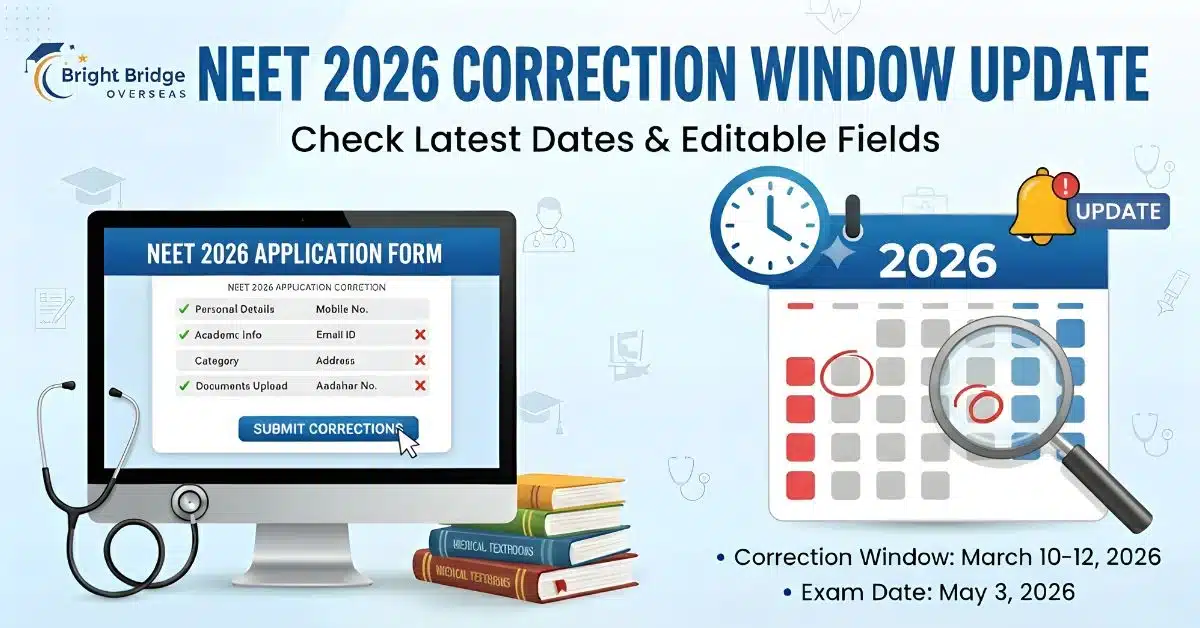

The NEET 2026 correction window update is one of the most crucial opportunities for medical…
The National Medical Commission (NMC) has recently introduced new guidelines for Indian students planning to pursue MBBS abroad in 2025-26. These updates are crucial for ensuring that students make informed decisions about their medical education and avoid falling into the trap of unrecognized colleges. For Indian aspirants dreaming of becoming doctors, understanding these changes is essential.
Why NMC Guidelines Matter for MBBS Abroad Students?
The NMC regulates medical education in India and also sets eligibility standards for Indian students studying medicine abroad. These guidelines directly impact whether a student’s MBBS degree from a foreign university will be valid for licensing exams like NEXT (National Exit Test) in India. Without NMC approval, students risk their degree not being recognized, which can block them from practicing as doctors in India.
Key Changes & Reinforced Rules in NMC’s New Guidelines
1. Minimum Course Duration
The MBBS program abroad must run at least 54 months (4.5 years) of academic and clinical instruction, plus a 12-month internship at the same institution. Failure to meet this minimum disqualifies the degree in the Indian context
2. Clinical Training Requirements
Students cannot split their internship between institutions or countries. The full 12-month internship must be completed in the same foreign medical university where they studied.
3. Medium of Instruction
All theory, practical, and clinical teachings must be in English. Universities offering bilingual or local-language instruction for core medical subjects risk non-recognition.
4. Curriculum Must Cover Core Indian MBBS Subjects
Foreign medical programs must include subjects such as General Medicine, Surgery, Pediatrics, Obstetrics & Gynecology, Psychiatry, Community Medicine, Anaesthesia, Orthopedics, Ophthalmology, ENT, Dermatology, and Emergency care, aligned with Indian syllabus norms.
5. NEET Qualification Remains Mandatory
Indian students must clear NEET-UG prior to enrolling abroad. NMC reiterates that this remains a non-negotiable eligibility requirement.
6. FMGE → NExT Transition
While FMGE currently remains the screening test for foreign graduates, NMC intends to fully replace FMGE with the National Exit Test (NExT) from 2025 onwards. Foreign MBBS graduates are expected to follow the same exit licensing exam path.
7. No Online / Hybrid Coverage for Clinical & Practical Courses
NMC clarifies that no part of clinical or practical training can be offered online or in hybrid mode. All hands-on training must occur physically at hospital settings.
8. Avoid Newly Established Colleges
The guidelines warn against joining very new universities unless they have proven credentials, infrastructure, and recognition. Such institutions often pose higher risks.
9. Transfers & Midcourse Migration Not Allowed
Students cannot transfer mid-course between foreign institutions or countries. Interruptions or switching colleges may lead to disqualification under the new rules.
Implications for Indian MBBS Aspirants
- Many borderline or low-duration programs will now be invalid for Indian licensing.
- Scholarships and admission offers from non-compliant institutions become risky.
- Students must rigorously check whether a foreign university adheres to all NMC criteria before enrollment.
- The shift toward NExT means students must be ready for standardized exams across Indian and foreign MBBS paths.
- The ban on hybrid clinical training underscores the importance of physical hospital access in the host country.
Planning MBBS abroad in 2025? Stay updated with NMC guidelines and choose recognised universities for a secure career. Contact us today!

Steps Students Should Take to Ensure Compliance
- Verify Program Duration & Internship Policy
Confirm the course is 54 months + 12 months internship in the same institution. - Check Syllabus & Subjects Covered
Match the subject list to Indian MBBS syllabus (Schedule I) and ensure inclusion of all clinical disciplines. - Confirm Medium of Instruction
Ask the university for official proof that teaching is 100% in English for all medical subjects. - Assess University Age, Recognition & Infrastructure
Avoid institutions younger than 10 years or lacking hospital tie-ups, labs, and accreditation. - Monitor NExT / Licensing Exam Announcements
Stay updated on when NEX T will be applicable to foreign graduates. - Demand Official Documentation
Request prospectus, recognition certificates, and official letters proving compliance before admission. - Document Everything
Keep email trail, admission letters, and acknowledgment of recognizing compliance by the university.
Expert Tips for Parents and Students
- Always check whether the university is listed with NMC.
- Verify details such as course duration, medium of instruction, and internship structure.
- Prefer reputed consultancies that work directly with NMC-recognised universities.
Frequently Asked Questions
Do these new NMC rules apply to students who already enrolled abroad?
It depends on the date of admission. Those already enrolled may fall under earlier rules depending on transitional clauses—check official NMC notifications.
If a foreign university offers part of clinical training in India, is that allowed?
No. The internship and clinical training must be entirely in the same foreign institution. Any mixing or relocation is not permitted.
Will FMGE still be required?
Yes, until NMC fully transitions to NExT for foreign graduates, FMGE remains the mandatory screening test.
Can a degree from a university that does not meet NMC criteria be validated later?
No, in most cases, such a degree will not be recognized for medical registration in India.
Conclusion
The NMC’s new MBBS abroad guidelines for 2025-26 aim to safeguard Indian students and ensure they receive high-quality education abroad. By following these updated rules, students can secure their medical careers and smoothly transition to practicing in India after completing their MBBS.
Explore Top Destinations for Studying MBBS Abroad!
Related Posts